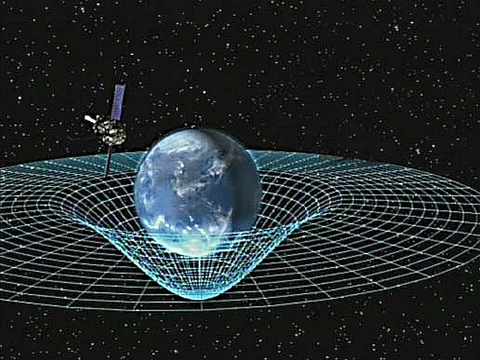
Spacetime
A four-dimensional continuum fusing space and time.

Spacetime is a mathematical model in physics that fuses the three dimensions of space and the one dimension of time into a single four-dimensional continuum. It is fundamental to understanding relativistic effects, such as how different observers perceive where and when events occur.
- field
- Physics
- known_for
- Fusing space and time into a four-dimensional continuum; basis of special and general relativity
- key_concept
- Minkowski space (1908)
Lore & Background
Until the turn of the 20th century, the assumption had been that the three-dimensional geometry of the universe was distinct from time. However, space and time took on new meanings with the Lorentz transformation and special theory of relativity. In 1908, Hermann Minkowski presented a geometric interpretation of special relativity that fused time and the three spatial dimensions into a single four-dimensional continuum now known as Minkowski space. This interpretation proved vital to the general theory of relativity, wherein spacetime is curved by mass and energy. In ordinary space, a position is specified by three numbers, known as dimensions. A point in spacetime is called an event, and requires four numbers to be specified: the three-dimensional location in space, plus the position in time. The path of a particle through spacetime is called its world line. Mathematically, spacetime is a manifold, appearing locally flat near each point. A scale factor, the speed of light, relates distances measured in space to distances measured in time. Henri Poincaré was the first to combine space and time into spacetime. He argued in 1898 that the simultaneity of two events is a matter of convention. In 1900 and 1904, he suggested the inherent undetectability of the aether by emphasizing the validity of what he called the principle of relativity. In 1905/1906 he mathematically perfected Lorentz's theory of electrons and introduced the innovative concept of a 4-dimensional spacetime by defining various four-vectors.
Reader's Guide
Spacetime is a cornerstone of modern physics, replacing the classical view of separate space and time. Its significance lies in providing a unified framework for understanding relativistic phenomena. In special relativity, time cannot be separated from the three dimensions of space, because the observed rate at which time passes for an object depends on the object's velocity relative to the observer. General relativity extends this by explaining how gravitational fields can slow the passage of time for an object as seen by an observer outside the field. The concept of spacetime also clarifies the nature of measurement: physicists distinguish between what one measures or observes after factoring out signal propagation delays, versus what one visually sees without such corrections. Spacetime diagrams are useful in visualizing relativistic effects. The legacy of spacetime includes its role in resolving experimental puzzles from the mid-1800s, such as the Fizeau experiment and the Michelson–Morley experiment, which showed discrepancies between observation and predictions based on Euclidean space. The work of Lorentz, Poincaré, and Minkowski established the mathematical and conceptual basis that Einstein later used in general relativity.
Did You Know?
- Spacetime is a mathematical model that fuses the three dimensions of space and the one dimension of time into a single four-dimensional continuum.
- A point in spacetime is called an event and requires four numbers to be specified: x, y, z, and t.
- Henri Poincaré was the first to combine space and time into spacetime, arguing in 1898 that the simultaneity of two events is a matter of convention.
- In 1908, Hermann Minkowski presented a geometric interpretation of special relativity that fused time and the three spatial dimensions into Minkowski space.
More in Relativity And Spacetime 1-22
Spotted an error? Know more?
This is a living reference — every entry is fact-audited, and reader corrections feed straight into our audit queue. Suggest an edit · See this site's audit record