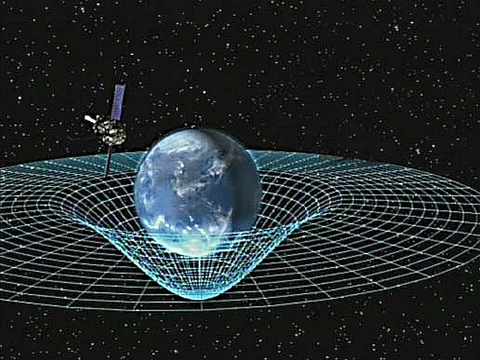
Moving magnet and conductor problem
A thought experiment on relativity and electromagnetism.

User:Stannered · CC BY 2.5
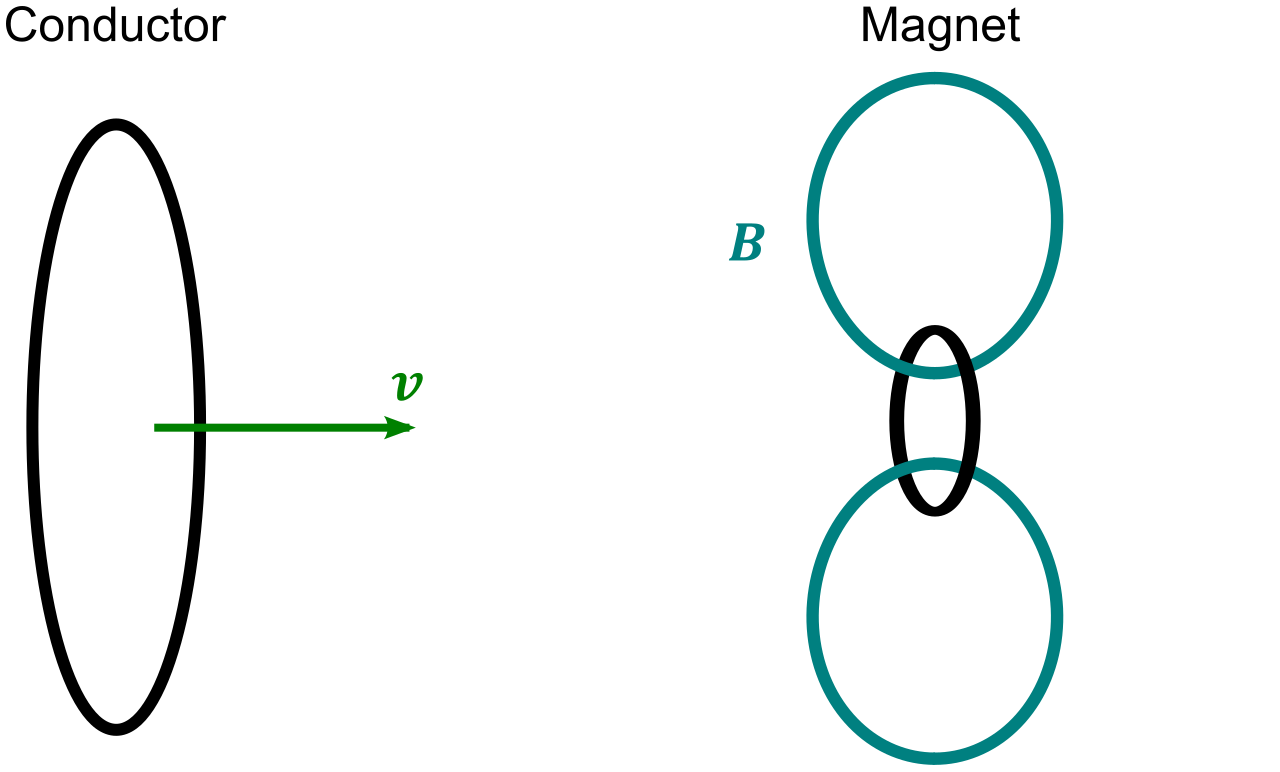
The moving magnet and conductor problem is a famous thought experiment from the 19th century that examines the intersection of classical electromagnetism and special relativity. It involves calculating the current in a conductor moving with constant velocity relative to a magnet, both in the magnet's frame of reference and the conductor's frame of reference, demonstrating that the observable current is the same in both cases.
- field
- Physics
- known_for
- Thought experiment illustrating relativity of electromagnetic fields
- type
- Thought experiment
Lore & Background
The problem originated in the 19th century as a thought experiment concerning the intersection of classical electromagnetism and special relativity. In it, the current in a conductor moving with constant velocity relative to a magnet is calculated in the frame of reference of the magnet and in the frame of reference of the conductor. The observable quantity, the current, is the same in either case, in accordance with the basic principle of relativity that only relative motion is observable and there is no absolute standard of rest.
Reader's Guide
The moving magnet and conductor problem is significant because it highlights a fundamental asymmetry in Maxwell's equations when applied to moving bodies, which Einstein addressed in his 1905 paper introducing relativity. According to Maxwell's equations, charges in the conductor experience a magnetic force in the magnet's frame and an electric force in the conductor's frame, yet the same phenomenon yields the same current. This problem, along with the Fizeau experiment, the aberration of light, and the Michelson–Morley experiment, formed the basis of Einstein's development of the theory of relativity. The problem underscores the need for consistency between Newtonian mechanics and electrodynamics, leading to the revision of force transformations in moving reference frames to be consistent with Lorentz invariance. It also illustrates that magnetic fields in one frame become electric fields in another, suggesting that the paradox may be semantic and that a frame-independent description can be achieved using scalar and vector potentials or the electromagnetic field tensor.
Did You Know?
- The moving magnet and conductor problem is a famous thought experiment originating in the 19th century.
- Einstein's 1905 paper that introduced relativity opens with a description of the magnet/conductor problem.
- According to Maxwell's equations, charges in the conductor experience a magnetic force in the magnet's frame and an electric force in the conductor's frame.
- The problem, along with the Fizeau experiment and the Michelson–Morley experiment, formed the basis of Einstein's development of the theory of relativity.
The Two Foundational Assumptions
In 1905, Albert Einstein published a paper titled "On the Electrodynamics of Moving Bodies" that would reshape physics. Remarkably, his entire framework rested on just two assumptions. The first, the principle of relativity, holds that the laws governing physical phenomena remain identical in every inertial frame of reference, meaning any frame that experiences no acceleration. This idea traces back to Galileo Galilei, who first articulated it through what is now called Galilean invariance. The second postulate, often called the principle of light speed invariance, asserts that the speed of light in a vacuum is the same for every observer, no matter how the light source or the observer themselves are moving. Both postulates apply specifically to observers traveling at a constant velocity relative to one another. Einstein illustrated this with everyday scenarios: an observer aboard a train witnesses natural phenomena behaving identically whether the train is in motion or at rest, and a person at a station measures light traveling at the same speed whether the beam originates from within the station or from a passing train. From these two deceptively simple starting points, an entirely new description of space and time unfolds.
Time, Space, and the Shattering of Absolutes
Before special relativity, the prevailing assumption was that time flowed uniformly across the entire universe. Einstein's theory dismantled this notion, replacing a single universal clock with a picture in which time is local to each observer. A practical way to express this is through clock ticks: a clock in motion relative to a stationary observer runs slower. Events that register as simultaneous on a stationary clock will register at different moments on a moving one. At the speeds people encounter in daily life, this slowing is far too tiny to detect, but as velocities approach the speed of light, the effect becomes dramatic and many physical phenomena can only be explained by incorporating relativistic corrections. The consequences cascade outward: the relativity of simultaneity, time dilation, length contraction, and the fact that velocities no longer add in the simple arithmetic way. When combined with other physical laws, the two postulates yield the famous mass-energy equivalence, E equals m c squared. Crucially, because information from distant objects cannot arrive faster than light, every visual observation actually reports events from the past, making intuitive descriptions of relativistic effects particularly error-prone.
A New Geometry for the Universe
One of the most profound structural changes brought by special relativity is the replacement of Euclidean geometry with what is now called Lorentzian geometry. In the familiar Euclidean framework, distances are computed using the Pythagorean theorem and involve only spatial coordinates. In Lorentzian geometry, the notion of distance is replaced by an interval that incorporates a time coordinate, distinguished by a minus sign in the calculation. A striking feature of this interval is that it carries the same numerical value for all observers, regardless of their relative velocity, making it an invariant quantity. When comparing coordinate systems in relative motion, the Lorentz transformation supersedes the Galilean transformation that had served Newtonian mechanics. The theory also demands relativistic corrections to the Doppler effect and introduces the Thomas precession. Perhaps most remarkably, special relativity explains how electricity and magnetism are fundamentally intertwined. Despite these sweeping conceptual shifts, the mathematics required to work through the theory sits at roughly the high-school level, which is unusual among the major topics of modern physics.
From Galileo's Ship to Maxwell's Equations
The intellectual lineage of special relativity stretches back to 1632, when Galileo Galilei proposed a thought experiment in which an observer inside a moving ship could not distinguish the vessel's motion from rest by watching natural phenomena unfold. His conclusions, later summarized as Galilean relativity, became the foundation of Newtonian mechanics. Isaac Newton refined the framework by noting that transformations involving rotation or acceleration would not preserve the appearance of physical laws, and he restricted his analysis to motion relative to an immovable absolute space, what we now call inertial frames. In 1864, James Clerk Maxwell introduced his theory of electromagnetism, which predicted a constant speed of light in vacuum independent of the motion, frequency, wavelength, direction, polarization, or phase of the light. This theory did not conform to Galilean relativity and was originally believed to be valid only in inertial frames anchored to a hypothetical aether. A series of experiments attempted to detect Earth's motion through this aether, culminating in the 1887 Michelson-Morley experiment, which confirmed the constancy of light speed and deepened the puzzle that Einstein would ultimately resolve.
Gallery
Frequently Asked Questions
What is Moving magnet and conductor problem?
It is a 19th-century thought experiment that sits at the crossroads of classical electromagnetism and special relativity. In the series it serves as the entry where you compute the induced current in a conductor sliding past a magnet from two different inertial frames and confirm the results agree.
What are Moving magnet and conductor problem's powers/role?
Its core 'power' is exposing how the electromagnetic field itself is frame-dependent: in the magnet's rest frame a motional EMF drives the current, while in the conductor's frame a Lorentz-transformed electric field does the work. Despite the different mechanisms, the observable current comes out identical in both descriptions.
How does Moving magnet and conductor problem's story end?
The calculation closes with both reference frames yielding the same current in the conductor, so no physical contradiction arises. That agreement is the punchline: the predictions are consistent, but the mechanism you invoke to explain them shifts with your choice of frame.
Why is Moving magnet and conductor problem important?
It is one of the cleanest textbook demonstrations that electric and magnetic fields are two facets of a single electromagnetic field that mixes under Lorentz transformations. Einstein himself pointed to this kind of frame-asymmetry as a key motivation for formulating special relativity.
What is the origin/backstory of Moving magnet and conductor problem?
The scenario was already well known among 19th-century physicists working with Maxwell's equations and Faraday's law, well before relativity was formalized. It became a canonical example precisely because it exposes the awkwardness of treating magnetism and electricity as fundamentally separate phenomena.
More in Relativity And Spacetime 1-22
Spotted an error? Know more?
This is a living reference — every entry is fact-audited, and reader corrections feed straight into our audit queue. Suggest an edit · See this site's audit record