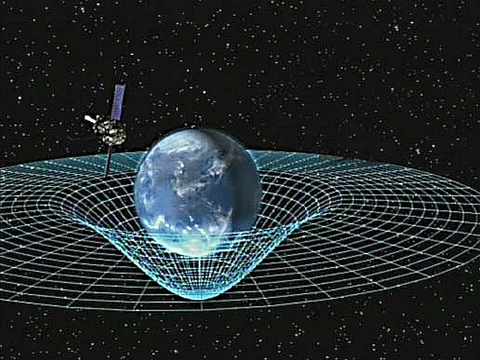
Problem of time
A conflict between quantum mechanics and general relativity over time.

cmglee · CC BY-SA 4.0
The problem of time is a conceptual conflict in theoretical physics between quantum mechanics and general relativity. Quantum mechanics treats the flow of time as universal and absolute, while general relativity regards it as malleable and relative. This raises fundamental questions about the physical nature of time, whether it is a real distinct phenomenon, and why time appears to flow in a single direction despite no known microscopic laws requiring it.
- field
- Theoretical physics
- known_for
- Conceptual conflict between quantum mechanics and general relativity regarding the nature of time
- related_theories
- Quantum gravity, Wheeler–DeWitt equation, Page–Wootters mechanism, consistent discretizations, thermal time hypothesis
Lore & Background
In quantum mechanics, time is treated as a classical background parameter external to the system, with measurements made at specific instants. In general relativity, time is a general coordinate, not a unique background parameter, and the field equations are formulated in terms of spacetime. These incompatible roles of time are central to quantum gravity, which attempts to reconcile the two theories. The frozen formalism problem arises from the Wheeler–DeWitt equation, where the energy operator becomes a constraint and the wave function of the universe is constant and does not evolve, contrasting with the time-dependent Schrödinger equation.
Reader's Guide
The problem of time remains an open question closely tied to theories of quantum gravity. Proposed solutions include the Page–Wootters mechanism, which suggests time emerges for internal observers through energy entanglement between an evolving system and a clock system. Other approaches include consistent discretizations, reduced phase-space quantization, and the thermal time hypothesis. The issue affects fundamental questions about whether time is fundamental or emergent, and how quantum probability relates to time.
Did You Know?
- The Wheeler–DeWitt equation describes a wave function of the universe that is constant and does not evolve, leading to the frozen formalism problem.
- The Page–Wootters mechanism suggests that time appears because of energy entanglement between an evolving system and a clock system within the universe.
- Consistent discretizations approach, developed by Jorge Pullin and Rodolfo Gambini, avoids constraints and provides a solution to the problem of time.
The Newton-to-Einstein Paradigm Shift
In classical mechanics, Newton envisioned all motion as occurring against a fixed, rigid Euclidean stage that stretched across every corner of space and every moment of time. Gravity, in this picture, was a mysterious influence that reached instantaneously across empty distance, entirely independent of whatever space lay between the interacting bodies. Einstein dismantled this picture entirely. He rejected the existence of any universal background frame and, more radically, denied that gravity is a force at all. In his formulation, what we call gravitational attraction is nothing more than the shape of spacetime itself. Objects do not get tugged by distant masses; they simply follow the straightest possible paths—geodesics—dictated by the local geometry around them. This reframing transformed gravity from an action-at-a-distance mystery into a geometric property of the arena in which all physical events unfold, a shift that would ultimately be encoded in Einstein's field equations.
Locality and the Tidal Signature of Curvature
A satellite circling Earth does not feel the pull of the Moon or the Sun in any direct sense. Because spacetime is locally flat on sufficiently small scales, the satellite is always tracing a straight line within its own immediate inertial neighborhood. No single freely falling particle can reveal the presence of gravity to an observer traveling alongside it. The true fingerprint of curvature emerges only when two separated bodies are compared. Two particles dropped near Earth's surface will drift apart or together relative to one another because the gravitational field is not perfectly uniform at every point. These tidal accelerations are strictly local in origin, yet their cumulative effect across many such small regions produces the appearance of a long-range gravitational pull. A thought experiment involving three observers—one who mistakes tidal effects for repulsive or attractive forces, one who recognizes the role of a central mass, and one who sees only geodesic motion—illustrates how deeply the interpretation of motion depends on the observer's theoretical framework.
Two Pillars: Coordinate Independence and Equivalence
General relativity rests on two foundational propositions that together redefine what it means for physics to be universal. The first is coordinate independence: the laws governing physical phenomena must hold regardless of which coordinate system an observer chooses. This is a sweeping extension of the special-relativity principle, which required only that inertial observers agree on the laws. In Einstein's own phrasing, the laws must apply to reference systems in any kind of motion whatsoever. The second pillar, the equivalence principle, resolves a tension this creates. In an accelerated frame, an observer feels forces that seem to reveal an absolute state of motion. Einstein's answer: in any sufficiently small region of space, the effects of gravity are indistinguishable from those of acceleration. A person in a small, uniformly accelerating spaceship far from any mass cannot, by any local experiment, tell the difference from a person standing in a box on Earth. Equivalently, the gravitational mass that appears in Newton's law of attraction must be exactly identical to the inertial mass in Newton's second law.
The Geometry of Distance: Spacetime Interval and Intrinsic Curvature
To move from intuitive pictures of curved spacetime to a complete mathematical description of gravitation, one must engage with tensor calculus and differential geometry—subjects that demand considerable study. Without these tools, one can write about general relativity in general terms but cannot demonstrate any non-trivial derivation. A key object in this formalism is the spacetime interval, an invariant measure of separation between two events that different observers can all agree upon. Its particular form is not merely a bookkeeping device; it encodes the geometric character of the space or spacetime on which it is defined. In a Euclidean plane, the Pythagorean theorem correctly gives the distance between points in right triangles, and conversely, if a surface's distances obey that theorem, the surface must be a Euclidean plane. Curved surfaces break this relationship, and the study of how they break it—what is called intrinsic curvature—lies at the heart of the geometric description of gravity. The interval thus serves as the bridge between the physical content of general relativity and the abstract differential geometry that makes precise statements about curved spacetime possible.
Gallery



Frequently Asked Questions
What is the Problem of time?
It is a deep theoretical tension in physics where quantum mechanics assumes a single, universal clock ticking for all of reality, while general relativity treats time as something that stretches, bends, and flows differently depending on gravity and motion. The two frameworks simply cannot agree on what time actually is.
Who is the Problem of time?
It is not a person but a conceptual problem in theoretical physics. It sits at the intersection of quantum mechanics and general relativity, highlighting that our two best theories describe time in fundamentally incompatible ways.
What are the Problem of time's key themes or "powers"?
Its central role is exposing that quantum mechanics bakes in an absolute, external time parameter, whereas general relativity dissolves time into a flexible dimension woven into spacetime geometry. Related efforts such as the Wheeler–DeWitt equation, the Page–Wootters mechanism, and the thermal time hypothesis all attempt to reconcile or dissolve this conflict.
How does the Problem of time's story end?
As of current physics, it has no resolution; it remains an open question that any successful theory of quantum gravity must address. Researchers continue exploring approaches like consistent discretizations and the Page–Wootters mechanism, but no consensus solution exists yet.
Why is the Problem of time important?
It strikes at the heart of whether time is a fundamental ingredient of reality or merely an emergent appearance, and it blocks the unification of quantum mechanics with general relativity. Without resolving it, a complete theory of quantum gravity cannot be written.
More in Relativity And Spacetime 1-22
Spotted an error? Know more?
This is a living reference — every entry is fact-audited, and reader corrections feed straight into our audit queue. Suggest an edit · See this site's audit record