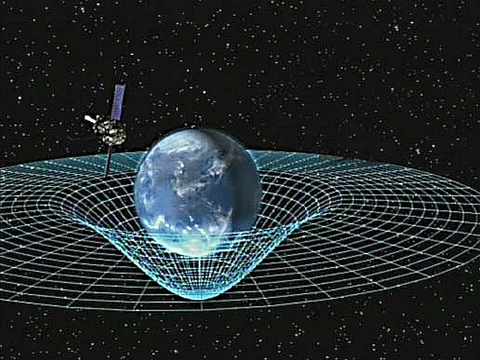
Poincaré group
Isometry group of Minkowski spacetime, fundamental to special relativity.

Unknown author Unknown author or not provided · Public domain
The Poincaré group, named after Henri Poincaré (1905), was first defined by Hermann Minkowski (1908) as the isometry group of Minkowski spacetime. It is a ten-dimensional non-abelian Lie group that is of importance as a model in our understanding of the most basic fundamentals of physics. The group consists of all coordinate transformations of Minkowski space that do not change the spacetime interval between events.
- Named after
- Henri Poincaré
- First defined by
- Hermann Minkowski
- Dimension
- Ten-dimensional
- Type
- Non-abelian Lie group
- Key property
- Isometry group of Minkowski spacetime
- Related group
- Lorentz group
Lore & Background
The Poincaré group consists of all coordinate transformations of Minkowski space that do not change the spacetime interval between events. For example, if everything were postponed by two hours, including the two events and the path you took to go from one to the other, then the time interval between the events recorded by a stopwatch that you carried with you would be the same. Or if everything were shifted five kilometres to the west, or turned 60 degrees to the right, you would also see no change in the interval. It turns out that the proper length of an object is also unaffected by such a shift. In total, there are ten degrees of freedom for such transformations. They may be thought of as translation through time or space (four degrees, one per dimension); reflection through a plane (three degrees, the freedom in orientation of this plane); or a 'boost' in any of the three spatial directions (three degrees). Composition of transformations is the operation of the Poincaré group, with rotations being produced as the composition of an even number of reflections.
Reader's Guide
The Poincaré group is the full symmetry group of special relativity, encompassing translations in time and space, rotations in space, and boosts connecting uniformly moving bodies. Its ten generators correspond, via Noether's theorem, to ten conservation laws: one for energy, three for momentum, three for angular momentum, and three for a quantity involving the velocity of the center of mass. In quantum field theory, the universal cover of the Poincaré group is more important because representations of the Lorentz group are not able to describe fields with spin 1/2, i.e., fermions. The Poincaré group is a semidirect product of the spacetime translations group and the Lorentz group. In general relativity, Poincaré symmetry applies only locally. Its positive energy unitary irreducible representations are indexed by mass and spin and are associated with particles in quantum mechanics.
Did You Know?
- The Poincaré group is a ten-dimensional non-abelian Lie group.
- It was first defined by Hermann Minkowski in 1908 as the isometry group of Minkowski spacetime.
- The group includes translations, rotations, reflections, and boosts.
- In quantum field theory, the universal cover of the Poincaré group is used to describe fermions.
Origins and the Geometry of Invariance
The Poincaré group carries the name of Henri Poincaré, whose 1905 work laid early groundwork for the concept, yet the formal identification as the isometry group of Minkowski spacetime was articulated by Hermann Minkowski in 1908. This dual attribution captures the interplay between Poincaré's pioneering relativity research and Minkowski's geometric re-casting of spacetime. At its core, the group collects every coordinate transformation of Minkowski space that leaves the spacetime interval between two events untouched. A concrete picture: shift every event in a scenario forward by two hours, slide the entire configuration five kilometres west, or rotate it by sixty degrees, and a stopwatch carried along the path still records the same interval. The proper length of an object is likewise preserved. These invariances under translation, rotation, and boost together delineate the group's scope, making it a foundational model for grasping the most basic structures of physics.
Algebraic Architecture and Degrees of Freedom
The Poincaré group is a ten-dimensional, noncompact, non-abelian Lie group whose ten parameters decompose neatly into four spacetime translations (one per dimension), three spatial rotations (equivalently the freedom to choose the orientation of a reflection plane), and three boosts along spatial axes. Rotations arise as the composition of an even number of reflections, and the group operation is simply the composition of successive transformations. Structurally, the four-dimensional abelian translation group sits as a normal subgroup, while the six-dimensional Lorentz group serves as the stabilizer of the origin. The Poincaré group is precisely the semidirect product of translations with O(1,3), and it is the smallest subgroup of the full affine group that contains every translation and Lorentz transformation. In informal language it is dubbed the inhomogeneous Lorentz group, underscoring that it extends the Lorentz group by a vector representation. It also emerges as a group contraction of the de Sitter group SO(4,1) in the limit where the de Sitter radius grows without bound.
Symmetry, Noether Laws, and the Classical-Relativistic Divide
Poincaré symmetry is the complete symmetry structure underlying special relativity, assembled from three transformation families: spacetime translations forming an abelian Lie group, spatial rotations forming a non-abelian group, and boosts that link uniformly moving frames. Rotations and boosts jointly constitute the Lorentz group, and the semi-direct product with translations yields the full Poincaré group. Objects invariant under this group are said to enjoy relativistic invariance. By Noether's theorem, the ten generators in four spacetime dimensions give rise to ten conservation laws: one for energy (time translations), three for linear momentum (spatial translations), three for angular momentum (spatial rotations), and three for a quantity tied to the velocity of the centre of mass (hyperbolic rotations mixing space and time). In classical physics the analogous ten-parameter Galilean group governs absolute time and space, swapping boosts for shear mappings between co-moving frames. Under gravity, as in general relativity, Poincaré symmetry survives only locally rather than globally.
Quantum Classifications and the Erlangen Perspective
In quantum mechanics the positive-energy unitary irreducible representations of the Poincaré group are labelled by a nonnegative mass and a spin that may be an integer or a half-integer. This is Wigner's classification, which maps these representations directly onto elementary particles. In quantum field theory the universal cover of the Poincaré group, written as the semidirect product of translations with SL(2,ℂ) or equivalently with the spin group Spin(1,3), becomes the more essential object. The practical reason is that representations of the ordinary SO(1,3) Lorentz group cannot accommodate spin-1/2 fields, i.e. fermions; the double cover removes that obstruction. Following the Erlangen programme, the geometry of Minkowski space is itself defined through the Poincaré group, with Minkowski space treated as a homogeneous space of the group. The group is thus not merely a symmetry acting on spacetime but the very structure from which flat-spacetime geometry is derived.
Gallery
Frequently Asked Questions
Who is the Poincaré group and where does the name come from?
The Poincaré group takes its name from the French mathematician Henri Poincaré, though it was actually first formally defined by Hermann Minkowski in 1908. It represents every possible way you can shift or rotate coordinates in flat spacetime without altering the interval between any two events.
What does the Poincaré group actually do for special relativity?
It serves as the complete set of symmetry transformations—translations plus rotations and boosts—that leave the Minkowski spacetime interval unchanged. In practical terms, it encodes the invariance principles that make the laws of physics look the same to all inertial observers.
How is the Poincaré group structured mathematically?
It is a ten-dimensional, non-abelian Lie group, meaning its elements do not generally commute and the group is described by ten continuous parameters. This makes it richer and more complex than a simple abelian group of translations alone.
Why do fans and physicists consider the Poincaré group so important?
It is the foundational symmetry group underlying all of special relativity, essentially defining what it means for physical laws to hold consistently across every inertial frame. Without it, the geometric framework of Minkowski spacetime would lack its defining invariance properties.
How does the Poincaré group connect to the Lorentz group?
The Lorentz group is a subgroup of the Poincaré group, handling only rotations and boosts about a fixed origin, while the Poincaré group additionally includes spatial and temporal translations. Together they form the full isometry group of flat spacetime, with the Lorentz part dealing with tilting and the translation part with shifting.
More in Relativity And Spacetime 1-22
Spotted an error? Know more?
This is a living reference — every entry is fact-audited, and reader corrections feed straight into our audit queue. Suggest an edit · See this site's audit record