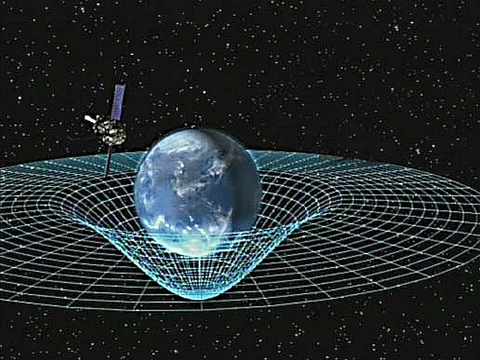
Principle of covariance
Principle requiring covariant formulation of physical laws.

The principle of covariance is a foundational concept in physics that emphasizes formulating physical laws using quantities whose measurements can be unambiguously correlated by observers in different frames of reference. It requires that physical quantities transform covariantly under a specific representation of the group of coordinate transformations between admissible frames, known as the covariance group.
- field
- Physics
- known_for
- Requiring physical laws to be formulated with covariantly transforming quantities
- related_theories
- Newtonian mechanics, special relativity, general relativity, weak interactions
Lore & Background
In Newtonian mechanics, the admissible frames are inertial frames with relative velocities much smaller than the speed of light. Time is absolute, and transformations between frames are Galilean transformations, forming the Galilean group. Covariant quantities are Euclidean scalars, vectors, and tensors, as exemplified by Newton's second law: m d\vec{v}/dt = \vec{F}. In special relativity, admissible frames are all inertial frames, with transformations being Lorentz transformations forming the Poincaré group. Covariant quantities include scalars, four-vectors, and objects like Dirac spinors. An example is the Lorentz force equation: m du^a/ds = q F^{ab} u_b. In general relativity, admissible frames are all reference frames, with transformations being arbitrary invertible and differentiable coordinate transformations. Covariant quantities are scalar fields, vector fields, and tensor fields on spacetime. The Einstein field equations are a main example.
Reader's Guide
The principle of covariance is significant because it provides a rigorous mathematical framework for ensuring that physical laws are independent of the observer's frame of reference. It does not require invariance under admissible transformations, though equations are often invariant; notably, in weak interactions, equations are not invariant under reflections but remain covariant. This principle underpins the formulation of theories from Newtonian mechanics to general relativity, guiding the selection of quantities that can be meaningfully compared across frames. Its legacy is evident in the structure of modern physics, where covariance is a key requirement for any fundamental theory, ensuring consistency and objectivity in describing physical phenomena.
Did You Know?
- The principle of covariance does not require physical laws to be invariant under the group of admissible transformations, although in most cases the equations are indeed invariant.
- In the theory of weak interactions, the equations are not invariant under reflections but are still covariant.
- In Newtonian mechanics, the admissible frames are inertial frames with relative velocities much smaller than the speed of light, and time is absolute.
- In general relativity, the admissible frames of reference are all reference frames, with transformations being all arbitrary invertible and differentiable coordinate transformations.
Defining What Counts as a Physical Law
The principle of relativity functions much like an axiom in mathematics — a foundational assumption upon which entire theoretical structures are erected. In the physical sciences, it serves as a guiding criterion for distinguishing genuine universal laws from observer-dependent artifacts. The core claim is straightforward: any phenomenon that different observers perceive differently cannot be classified as a fundamental law of nature; it is merely incidental to the particular vantage point of the observer. What persists unchanged across all observers becomes the candidate for a true physical law. This criterion proves especially powerful in dynamics and kinematics, the branches concerned with forces and the motion of bodies. The word "relative" acknowledges that every measurement is inherently tied to the observer who makes it, while "universal" hints at deeper rules that connect one observer's measurements to another's. In this way, the principle does not merely describe how physics works — it prescribes the very structure that any acceptable physical theory must possess before it can be taken seriously.
From Galileo's Ship to Einstein's Postulate
The intellectual lineage of the relativity principle stretches back to 1632, when Galileo Galilei illustrated the idea through the now-famous metaphor of a ship's cabin in his Dialogue Concerning the Two Chief World Systems. He never coined a name for the concept, but the intuition was clear: the mechanical behavior of objects inside a smoothly moving vessel is indistinguishable from that in a stationary one. Newton later wove this metaphor into the Scholium of his Principia, using it as a springboard for his laws of motion, gravitation, and his assertions about absolute space and time. The idea circulated widely through the nineteenth century, particularly in discussions of electromagnetism, yet it remained unnamed until 1904, when Henri Poincaré explicitly labeled it the "principle of relativity" in a French-language statement. Albert Einstein then took a decisive step in 1905, elevating the special principle from a useful observation to a foundational postulate of his new theory, pairing it with the constancy of the speed of light in vacuum.
The Electromagnetic Crisis and the Lorentz Solution
When James Clerk Maxwell formulated his equations of electromagnetism, the calculated speed of light matched experimental values with striking precision. Yet the prevailing understanding held that waves required a material medium — the luminiferous aether — through which to propagate. This created a deep tension: if an observer had absolute motion relative to the aether, the relativity principle as Poincaré had defined it would be violated. To patch the inconsistency, physicists such as Joseph Larmor and Hendrik Lorentz explored hypotheses including length contraction, and they ultimately discovered that Maxwell's equations remained invariant only under a specific set of variable changes now called the Lorentz transformations. In 1905, both Poincaré and Einstein published papers on electrodynamics showing that, once the Lorentz transformations were adopted, the relativity principle held without exception. Einstein went further by deriving those very transformations from the principle itself combined with the source-independence of light speed, thereby forcing a complete re-examination of what space and time intervals actually mean.
Symmetry, Conservation, and Predictive Power
Beyond its role as a definitional filter for physical laws, the relativity principle carries profound mathematical consequences. Because it demands that the form of a law remain identical across all permissible coordinate systems and observers, it imposes a symmetry on the structure of physical theory. A landmark result in mathematics, Noether's theorem, establishes that every continuous symmetry corresponds to a conservation law. Thus, if a physical law looks the same to observers at different moments in time, energy must be conserved; the symmetry of the law directly generates the conservation rule. This connection transforms the relativity principle from a philosophical guideline into a source of concrete, testable predictions about how nature must behave. In special relativity, the Maxwell equations retain their form in every inertial frame; in general relativity, both the Maxwell equations and the Einstein field equations preserve their form in arbitrary frames of reference, including those in accelerated or non-uniform motion. The principle thereby unifies the mathematical language of physics across an ever-widening class of observers.
Frequently Asked Questions
What is the Principle of covariance?
It is a foundational rule in physics demanding that every law be written with quantities that transform consistently when an observer switches reference frames. In practical terms, the mathematical structure of a physical equation must look the same to all valid observers, regardless of how they slice spacetime.
Who is Principle of covariance?
It is not a character but a structural mandate that sits beneath the entire Relativity And Spacetime framework. It insists that any quantity appearing in a physical law must belong to a well-defined representation of the covariance group, the set of all allowed coordinate changes between admissible frames.
What role does Principle of covariance play across the series?
It acts as the unifying thread linking Newtonian mechanics, special relativity, general relativity, and even weak-interaction theory into one coherent language. Without it, the same physical process would be described by different-looking equations in different frames, destroying the internal consistency of the theory.
How does Principle of covariance connect to weak interactions?
The same covariant-formulation requirement applies to the equations governing the weak nuclear force, so processes like beta decay remain frame-independent. This shows the principle is a cross-cutting demand of modern physics rather than a rule limited to gravity or electromagnetism.
Why is Principle of covariance important?
It guarantees that the numerical predictions of physics do not depend on which valid coordinate system an observer happens to use. Stripping it away would make the entire relativistic edifice observer-dependent and internally contradictory.
More in Relativity And Spacetime 1-22
Spotted an error? Know more?
This is a living reference — every entry is fact-audited, and reader corrections feed straight into our audit queue. Suggest an edit · See this site's audit record