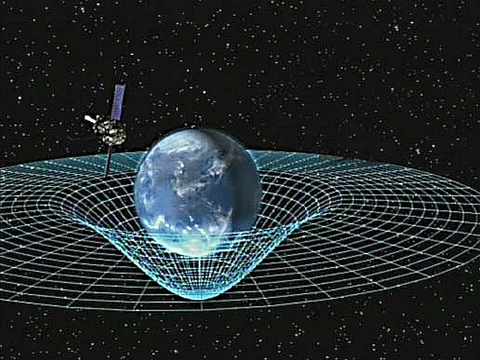
Minkowski spacetime
Four-dimensional model unifying space and time in special relativity.

Simon Tyran, Vienna (Yukterez) · CC BY 4.0
Minkowski spacetime is the main mathematical description of spacetime in the absence of gravitation, combining inertial space and time manifolds into a four-dimensional model. It was developed by mathematician Hermann Minkowski from the work of Hendrik Lorentz, Henri Poincaré, and others, and is closely associated with Einstein's theories of special relativity and general relativity.
- field
- Physics, Mathematics
- known_for
- Minkowski spacetime, four-dimensional spacetime model, Minkowski diagram
Lore & Background
Minkowski spacetime was developed by mathematician Hermann Minkowski from the work of Hendrik Lorentz, Henri Poincaré, and others. Minkowski said it 'was grown on experimental physical grounds'. In the 1890s, Lorentz began developing theories of electrodynamics based on a pervasive luminiferous aether, using transformations that would bear his name. Poincaré's 1905 relativity paper described invariants like x² + y² + z² − t², but did not introduce the imaginary coordinate ict; that was introduced by Minkowski in his 1907–1908 work. Minkowski elaborated these concepts in a 1908 paper called 'Die Grundgleichungen für die elektromagnetischen Vorgänge in bewegten Körpern' (The Fundamental Equations for Electromagnetic Processes in Moving Bodies), introducing tensors and reformulating Maxwell's equations as a symmetrical set in four variables (x, y, z, ict). He concluded that time and space should be treated equally, leading to his concept of events in a unified four-dimensional spacetime continuum. On September 21, 1908, he presented his ideas in a lecture in Cologne, Germany, known as the 'Space and Time' lecture (published in 1909), where he stated: 'Henceforth, space by itself and time by itself are doomed to fade away into mere shadows, and only a kind of union of the two will preserve an independent reality.' He introduced the Minkowski diagram and used it to define concepts like proper time and length contraction. Minkowski spacetime is a pseudo-Euclidean space equipped with an isotropic quadratic form called the spacetime interval or Minkowski norm squared. Unlike Euclidean space, the interval between two distinct events can be zero when one event is on the light cone of the other. The group of transformations preserving the spacetime interval is the Lorentz group. The causal structure classifies vectors as timelike, spacelike, or null (lightlike), with the set of all null vectors at an event constituting its light cone.
Reader's Guide
Minkowski spacetime is significant as the foundational mathematical structure for special relativity, providing a unified four-dimensional model where the spacetime interval between events is invariant across inertial frames. It differs from four-dimensional Euclidean space by treating time differently from spatial dimensions. The model helped show how length contraction and time dilation arise from different frames of reference, while all frames agree on the total spacetime interval. Minkowski's four-vector approach became the standard language for understanding relativity, showing that electric and magnetic fields transform into one another depending on the observer's inertial frame. Though Einstein was not initially enthusiastic, Minkowski's concept of spacetime became the basis for developing relativistic mechanics and later influenced general relativity. The causal structure of Minkowski spacetime, with its light cones and classification of vectors, remains essential for understanding relativistic causality. The Poincaré group, which includes Lorentz boosts and translations, governs the symmetries of this spacetime.
Did You Know?
- Minkowski spacetime combines inertial space and time manifolds into a four-dimensional model.
- The spacetime interval between two events can be zero when one event is on the light cone of the other.
- Minkowski introduced the Minkowski diagram to define concepts like proper time and length contraction.
- The group of transformations preserving the spacetime interval is the Lorentz group, not the Galilean group.
From Lorentz Transformations to a Unified Continuum
In the 1890s, Hendrik Lorentz was developing electrodynamics theories grounded in a luminiferous aether separate from matter. Between 1892 and 1904, he published a series of papers employing mathematical transformations that would later carry his name. Henri Poincaré, particularly in his second relativity paper of 1905, took a bold geometric step: he treated time as an imaginary fourth coordinate (ict) and showed that Lorentz transformations could be visualized as ordinary rotations in four-dimensional space, with the rotation axis tied to the direction of relative motion and the angle linked to relative velocity. Poincaré also identified invariants under these rotations, such as the quantity x² + y² + z² − t². Minkowski, well acquainted with Poincaré's work, took these ideas further in a 1908 German-language paper on electromagnetic processes in moving bodies. There he introduced tensors into the mathematical language of physics and recast Maxwell's equations as a symmetric set across four variables, demonstrating their invariance under Lorentz transformation. From this reformulation, he drew the radical conclusion that space and time deserved equal treatment, giving birth to the concept of a unified four-dimensional spacetime continuum.
The Cologne Lecture and the Birth of a New Geometry
In 1908, Minkowski delivered what would become one of the most celebrated lectures in the history of physics, presented in Cologne before a mixed audience of physicists and mathematicians. He opened with a declaration that would echo through the decades: the views he was about to present had sprung from the soil of experimental physics, and in that experimental grounding lay their strength. He then made his now-iconic pronouncement that space by itself and time by itself were doomed to fade away into mere shadows, with only their union preserving independent reality. Yet despite this experimental starting point, the body of the lecture was deeply mathematical. Minkowski championed the four-vector representation of coordinates and velocities, and he introduced what we now call the Minkowski diagram. Using this graphical tool, he defined proper time, illustrated length contraction, and provided a geometrical reading of how Newtonian mechanics generalizes into relativistic mechanics. The broader effect was to reposition mathematics not as a mere convenience for physicists but as a window into the deep structure of physical reality itself.
A Geometry That Defies Euclidean Intuition
Minkowski spacetime is a pseudo-Euclidean space, and that qualifier carries enormous weight. It is equipped with an isotropic quadratic form known as the spacetime interval or the Minkowski norm squared. In ordinary three-dimensional Euclidean space, the distance between any two distinct points is always strictly positive. In Minkowski spacetime, however, the interval between two distinct events can be exactly zero—this happens precisely when one event lies on the light cone of the other. Through the polarization identity, the quadratic form can be converted into a symmetric bilinear form called the Minkowski inner product, though it is emphatically not a geometric inner product in the Euclidean sense. The group of transformations that preserves this spacetime interval, as opposed to the spatial Euclidean distance, is the Lorentz group, standing in contrast to the Galilean group of classical mechanics. When time is appended as a fourth dimension to the three spatial ones, the transformation group gains translations in time and Lorentz boosts on top of the familiar rotations, reflections, and translations, yielding what is called the Poincaré group.
The Invariant Heart of Special Relativity
Minkowski spacetime is the most common mathematical structure through which special relativity is formalized, and it is closely associated with both Einstein's special and general relativity. Its defining physical virtue is the invariance of the spacetime interval: no matter which inertial frame of reference records two events, every observer will agree on the total interval separating them. This stands in sharp contrast to the individual components of space and time, which do shift from frame to frame due to length contraction and time dilation. The model thus reveals a deeper unity beneath the apparent disagreement of observers. Minkowski's framework follows special relativity's prediction that motion induces time dilation, altering the scale applied to a moving frame, and shifts the phase of light. Importantly, Minkowski spacetime describes the universe in the absence of gravitation, making it the flat, gravitational-free backdrop against which the curved geometries of general relativity are defined. Minkowski himself regarded Einstein's 1905 paper as establishing a new understanding of time as a local phenomenon, a consequence of the relativity of simultaneity, and he saw his own contribution as transforming the fundamental conception of what space and time actually are.
Gallery
Frequently Asked Questions
What is Minkowski spacetime?
It is a four-dimensional mathematical framework that fuses the three dimensions of space with time into one unified manifold. It serves as the standard geometric description of flat spacetime in special relativity, where no gravitational fields are present.
Who created Minkowski spacetime?
Mathematician Hermann Minkowski formalized the model in 1908, building on earlier contributions by Hendrik Lorentz, Henri Poincaré, and others. His work supplied the geometric language that made Einstein's special relativity far more elegant and intuitive.
What is a Minkowski diagram?
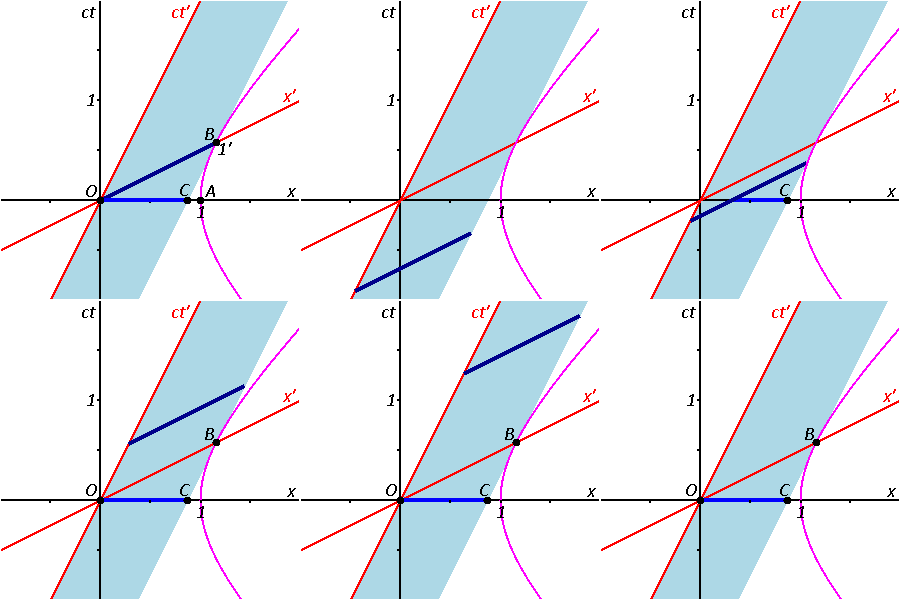
It is a two-dimensional graphical tool that plots one spatial axis against a time axis to visualize how events transform between inertial observers. These diagrams make concepts like time dilation, length contraction, and the relativity of simultaneity easy to see at a glance.
How does Minkowski spacetime relate to general relativity?
In general relativity, spacetime is no longer flat but curved by mass and energy, described by the broader framework of pseudo-Riemannian geometry. Minkowski spacetime acts as the local, zero-curvature limit you recover in sufficiently small regions where gravity is negligible.
Why is Minkowski spacetime considered important in physics?
It replaced the old Newtonian picture of absolute space and absolute time with a single geometric entity, fundamentally reshaping how physicists describe motion and causality. Nearly every modern treatment of special relativity, particle physics, and quantum field theory rests on this four-dimensional foundation.
More in Relativity And Spacetime 1-22
Spotted an error? Know more?
This is a living reference — every entry is fact-audited, and reader corrections feed straight into our audit queue. Suggest an edit · See this site's audit record