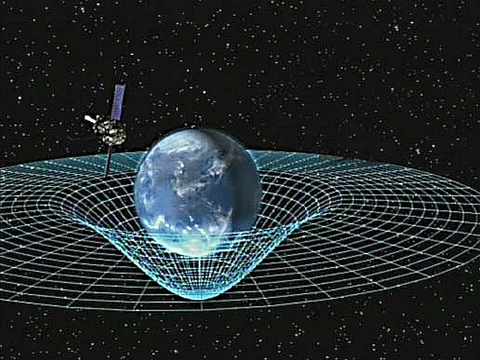
Principle of locality
An object is influenced directly only by its immediate surroundings.

Elowe86 · CC BY-SA 4.0
The principle of locality is a foundational concept in physics stating that an object is directly influenced only by its immediate surroundings. It evolved from classical field theories and contrasts with the idea of instantaneous action at a distance, requiring that any causal influence be mediated by something—such as a wave or particle—traveling through space.
- field
- Physics
- known_for
- Stating that an object is influenced directly only by its immediate surroundings; limiting causal influence to the speed of light via special relativity; playing a critical role in the EPR paradox and
Lore & Background
The principle of locality evolved out of the field theories of classical physics. It holds that for a cause at one point to have an effect at another point, something in the space between must mediate the action, such as a wave or particle carrying the influence. The special theory of relativity limits the maximum speed of causal influence to the speed of light, implying that an event at one point cannot cause a truly simultaneous result at another point; the minimum time for influence is the distance divided by the speed of light.
Reader's Guide
The principle of locality plays a critical role in quantum mechanics. Progressive Bell test experiments have since shown that quantum mechanics broadly violates Bell's inequalities, leading some interpretations to conclude that some quantum effects violate the principle of locality. Historically, Newton's universal gravitation violated locality as action at a distance, which Newton himself found absurd. Coulomb's law was initially instantaneous, but Maxwell's field equations later showed electromagnetic forces propagate at the speed of light, obeying locality. Einstein's special and general relativity reformulated physics to obey locality, though quantum mechanics later challenged it.
Did You Know?
- Newton considered action at a distance to be 'so great an Absurdity' that he believed no competent thinker could accept it.
- The principle of locality implies that an event at point A cannot cause a result at point B in a time less than T = D/c, where D is the distance and c is the speed of light.
Defining What Counts as a Physical Law
The principle of relativity functions almost like an axiom in the physical sciences, serving as a foundational guide rather than a derived result. At its core, it asserts that the laws governing nature must be universal—identical for every observer regardless of their state of motion or location. This assertion does more than describe how physics works; it actually defines what qualifies as a physical law. If two observers disagree on a phenomenon, that disagreement is incidental to their particular vantage point, not a fundamental rule. Only what remains invariant across all observers earns the status of a genuine law. The term "relative" acknowledges that every measurement is anchored to a specific observer and their chosen coordinate system, while "universal" hints at deeper rules connecting one observer's measurements to another's. This framework proves especially powerful in dynamics and kinematics, where forces and motion are described. The principle essentially filters out observer-dependent artifacts, leaving behind the structural backbone of physical reality.
From Galileo's Ship to Poincaré's Naming
The intellectual seeds of relativity were sown by Galileo Galilei in 1632, when he used the metaphor of a ship's cabin in his Dialogue Concerning the Two Chief World Systems to illustrate that mechanical experiments yield the same results whether the vessel is at rest or moving uniformly. He never attached a formal name to the concept. Newton later incorporated this ship metaphor into the Scholium following his definitions in the Principia, building his laws of motion upon it. For over two centuries the idea circulated implicitly within Newtonian mechanics and, by the mid-nineteenth century, had become widespread in discussions of electromagnetism. Yet the phrase "principle of relativity" was not formally coined until 1904, when Henri Poincaré declared in French that the impossibility of demonstrating absolute motion appeared to be a general law of nature, and he named it accordingly. This formalization set the stage for Einstein's 1905 work, which elevated the principle from a useful observation to a foundational postulate of an entirely new theory.
Symmetry, Conservation, and Testable Predictions
A profound mathematical consequence of demanding that physical laws maintain identical form across all observers is the emergence of symmetry. When a law looks the same to observers at different locations or times, it possesses a continuous symmetry, and Noether's theorem guarantees that each such symmetry corresponds to a conservation law. For instance, if the laws are unchanged for observers at different moments in time, energy conservation follows as a necessary consequence. This connection transforms the relativity principle from a philosophical statement into a source of concrete, testable predictions about how nature must behave. The principle also governs how models are constructed: theoretical physics typically expresses observations as systems of equations with free parameters, and the form of those equations depends heavily on the coordinate system an observer selects. A falling body traces a simple curve in Cartesian coordinates but a far more tangled expression in time-varying ellipsoidal coordinates. The relativity principle demands that despite these superficial differences, the underlying law remains the same, constraining what forms are physically admissible.
From Inertial Frames to Arbitrary Motion
The principle of relativity manifests in two distinct tiers depending on what restrictions are placed on the observers' motion. In the special case, Einstein formulated the principle for uniform translational motion: if physical laws take their simplest form in one coordinate system, they retain that form in any other system moving at constant velocity relative to the first. This defines an inertial frame and underpins both Newtonian mechanics—where invariance is expressed through Galilean transformations—and special relativity, where the Lorentz transformations play that role. Max Planck considered the principle's influence on the latter so dominant that he named the entire theory after it. In the general case, no restriction on relative motion is imposed. Classical physics handled accelerated frames by introducing fictitious forces, somewhat ad-hoc corrections. General relativity dispenses with these artificial constructs entirely, requiring instead that the Einstein field equations and Maxwell's equations retain the same form in arbitrary frames of reference, a far more demanding and elegant requirement.
Gallery
Frequently Asked Questions
What is the Principle of Locality?
The Principle of Locality is a foundational rule in physics asserting that an object can only be directly affected by what is immediately around it, not by distant events in an instant. It grew out of classical field theory and became a cornerstone of how we think about cause and effect in spacetime.
What role does the Principle of Locality play in special relativity?
It enforces the idea that no causal signal can outrun light, meaning every influence must be carried by something—like a field disturbance or a particle—moving through space at or below the speed of light. This rules out the old Newtonian picture of gravity or magnetism acting instantly across empty space.
How does the Principle of Locality connect to the EPR paradox?
Einstein, Podolsky, and Rosen used locality as a key assumption to argue that quantum mechanics must be incomplete, because entangled particles seemed to affect each other faster than light. Bell later showed that any theory respecting locality and realism must obey certain statistical bounds, which experiments have since violated.
Why is the Principle of Locality important to the broader story of relativity and spacetime?
It provides the logical glue that keeps cause and effect ordered in a universe without a preferred rest frame, preventing paradoxes where an effect precedes its cause. Without it, the clean causal structure that special and general relativity depend on would collapse.
How does the Principle of Locality differ from the idea of action at a distance?
Action at a distance lets one object instantaneously tug on another no matter how far apart they are, while locality demands a physical intermediary travel between them. Modern field theories and relativity side firmly with locality, treating the intervening field as the true carrier of influence.
More in Relativity And Spacetime 1-22
Spotted an error? Know more?
This is a living reference — every entry is fact-audited, and reader corrections feed straight into our audit queue. Suggest an edit · See this site's audit record